
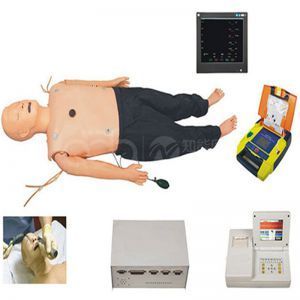
Product Description
Model | BIX/ACLS850 — Senior Multifunctional Adult Comprehensive First Aid Training Simulator |
Summary | Adult ACLS training simulator: CPR with auto-scoring, oral/nasal intubation, real defibrillation, 16+ ECG rhythms, vital signs, injections and nursing care. (156 chars) |
Type | ACLS-grade full-body adult simulator with computer monitor |
Guideline Basis | International CPR guidelines, 2020 update |
Package | ACLS computer monitor + intelligent adult simulator + advanced arm BP unit + airway components |
Price | On request |
Category | ACLS series (advanced life support simulators) |
Audience | Hospitals, medical schools, emergency-training centers, simulation labs, nursing schools |
Educational-use note: training simulator — educational equipment, not a medical device or pharmaceutical product (manufacturer's page notice). Confirm monitor language options and consumables with the specification sheet.
1. Why One Workstation Beats Three Trainers
ACLS courses teach a megacode: a cardiac arrest in which a team must compress, ventilate, intubate, read the monitor, defibrillate, give drugs and coordinate roles — all in minutes. Traditionally that meant separate CPR manikins, airway heads and ECG/defibrillation trainers: three stations, three instructors, three logistics chains.
The ACLS850 collapses the chain into one body: the same full-size adult simulator supports compression practice with automatic scoring, oral and nasal intubation with tooth-pressure alarm, real defibrillation and pacing with genuine hospital defibrillators, ECG monitoring across 16+ rhythms, simulated vital signs (pupils, carotid pulse, breathing, groaning, coughing, vomiting, airway obstruction, laryngospasm), injections/infusions/blood-pressure measurement, and nursing care with interchangeable male/female genitalia for catheterization. Simulation-based education is central to ACLS preparation — candidates practice standardized ventricular-fibrillation arrest scenarios before facing real codes (Gianotto-Oliveira et al., 2026) — so consolidating the full path from basic compressions to the team megacode on one workstation raises station throughput and lowers per-trainee equipment cost.
2. Evidence: Why These Modules Are the Right Ones
Evidence | Finding | Module It Supports |
Panchal et al., 2020 (AHA 2020 Part 3) | High-quality CPR is the strongest determinant of survival; depth 5–6 cm, rate 100–120/min | CPR auto-scoring |
Meaney et al., 2013 (Circulation) | Depth, rate, recoil and interruptions define CPR quality — and quality predicts outcomes | CPR feedback |
Abella et al., 2005 (JAMA) | Compressions during real arrests are frequently too shallow/slow versus guidelines | Objective scoring |
Gilfoyle et al., 2023 (JAHA) | Real-time feedback is associated with higher-quality compressions by ambulance personnel | Feedback training |
AHA 2000, Part 4 (AED) | Survival falls ~7–10% per minute of delayed defibrillation | Defib module |
Gianotto-Oliveira et al., 2026 (JMIR Med Educ) | Simulation-based education is crucial for ACLS training; standardized VF scenarios assess teams | Megacode station |
3. The Seven Training Modules in Detail
Module | What Trainees Practice |
1. CPR & ventilation | Single/multi-rescuer compressions and rescue breathing per 2020 guidelines; automatic scoring, real-time graphics, voice prompts, printable results |
2. Airway management | Oral and nasal intubation, head-tilt/jaw-thrust, tooth-pressure alarm for safe laryngoscopy practice |
3. Real defibrillation & pacing | Compatible with defibrillators and pacemakers of various brands — trainees use genuine clinical equipment, not look-alikes |
4. ECG monitoring | 16+ cardiac rhythms on 3/4-lead monitor connection; rhythm recognition across arrest and peri-arrest states |
5. Vital-sign simulation | Pupil change, carotid pulsation, breathing, groaning, coughing, vomiting, airway obstruction, laryngospasm |
6. Injections, infusions & BP | IV injection (arm), IM injection (thigh), infusion therapy, BP measurement on the advanced arm unit |
7. Nursing care | Interchangeable male/female external genitalia for bladder-catheterization training; movable ankle joint |
Megacode workflow on one simulator
1. Team enters; the simulator presents a shockable rhythm on the monitor.
2. Compressions with auto-scored feedback begin; airway team intubates (tooth alarm verifies technique).
3. The team delivers a real shock; vital signs update (pulse returns, pupils react) and results print for debrief.
4. Where the ACLS850 Sits in the BIX ACLS Family
Model | Positioning |
BIX/ACLS800A | Single unit: airway/lung-block control, XD1100A ECG simulator, detachable injection modules — low consumable cost for skills drilling |
BIX/ACLS850 | Flagship single unit: full vital-sign simulation + real defibrillation + nursing — one-workstation megacode trainer (this guide) |
BIX/ACLS8000 | System-level: teaching software, case library, question bank, multi-parameter monitoring — for simulation labs |
BIX/ACLS1700A | Pediatric version of the comprehensive simulator line |
Buying logic: the 850 gives a complete ACLS course on one workstation; pair 800A units for high-frequency drilling alongside one 850 for the integrated megacode, and choose 8000 when building a dedicated simulation lab.
5. Teaching Protocols
Station | Time | Activity |
A. Skill drills | 15 min each | Compression scoring; intubation; defibrillation sequencing |
B. Rhythm recognition | 20 min | Identify 16+ ECG rhythms on the monitor |
C. Megacode | 20 min/team | Full VF arrest scenario with roles, real defibrillator, debrief |
D. Vital-signs & nursing | 15 min | Pupil/carotid checks; catheterization practice |
Debrief checklist
● Compression metrics from the printed report
● Time-to-shock vs the 7–10%/minute survival decay benchmark; airway events; team coordination
6. Maintenance
Item | Frequency | Notes |
Airway & lungs | Per syllabus | Replace consumables per training load |
Skin/surface | After each session | Wipe with standard disinfectant |
ECG/monitor system | Monthly | Check leads; firmware per manufacturer |
Injection sites | As needed | Replace pads to keep resistance realistic |
Annual service | Yearly | Full calibration and inspection |
7. FAQ
Q1: Which CPR guideline is the ACLS850 based on? A: It is developed to the 2020 international CPR guidelines, with single/multi-rescuer CPR, automatic scoring, real-time graphics, voice prompts and printable results.
Q2: Does it work with real defibrillators? A: Yes — it is compatible with defibrillators and pacemakers of various brands, so trainees practice on genuine clinical equipment.
Q3: How is the ACLS850 different from the ACLS800A? A: The 800A emphasizes airway/lung-block control and low-consumable skills drilling (XD1100A ECG simulator). The 850 adds full vital-sign simulation plus real-defibrillation support — the integrated one-workstation megacode trainer.
Q4: How is it different from the ACLS8000? A: The 850 is a single multifunctional simulator; the 8000 is a system with teaching software, case libraries, question banks and multi-parameter monitoring for a full simulation lab.
Q5: What is the MOQ and price? A: Price is on request — it varies with configuration and volume. MOQ is 1 unit. Email cpr480@adaanatomy.com for the quotation and specification sheet.
Q6: What is the delivery time and after-sales support? A: Air freight 7–10 business days; sea freight 30–45 days. Manuals, training video and after-sales service included. Contact cpr480@adaanatomy.com for details.
References
Part 3: Adult Basic and Advanced Life Support — 2020 AHA Guidelines for CPR and ECC — Panchal et al. (2020), Circulation 142(16 Suppl 2):S366–S468
Cardiopulmonary Resuscitation Quality: Improving Cardiac Resuscitation Outcomes Both Inside and Outside the Hospital — Meaney et al. (2013), Circulation 128(4):417–435
Quality of Cardiopulmonary Resuscitation During In-Hospital Cardiac Arrest — Abella et al. (2005), JAMA 293(3):305–310
Association of Real-Time Feedback and Cardiopulmonary-Resuscitation Quality Delivered by Ambulance Personnel for Out-of-Hospital Cardiac Arrest — Gilfoyle et al. (2023), J Am Heart Assoc 12(20):e029457
Part 4: The Automated External Defibrillator — Key Link in the Chain of Survival (2000), Circulation 102(Suppl 1):I-60–I-76
Remote Augmented Reality Versus Traditional Simulation for Team Leader Assessment in a Cardiac Arrest Scenario: Noninferiority RCT — Gianotto-Oliveira et al. (2026), JMIR Med Educ 12:e84367