
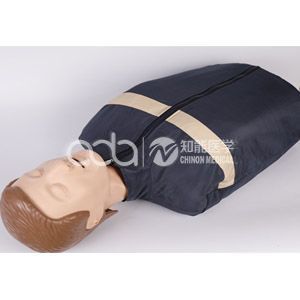
Product Description
Model | BIX/CPR230 — Computer Half Body CPR Training Manikin |
Summary | Computer CPR training manikin with depth lights, voice prompts, correct/wrong counters, 30:2 tracking, exam mode and pupil response. |
Airway | Simulation standard open airway display |
Compression Feedback | Depth lights: 5–6 cm green, under 5 cm yellow, over 6 cm red; correct/wrong counters; sound prompt stating error and reason |
Ventilation Feedback | Inhalation volume indicated from 500/600 ml to 1000 ml; counters; sound prompting |
Ratio & Cycle | 30:2 (one or two rescuers); one cycle = five sets of 30:2; 100 compressions per minute (page-stated target) |
Modes & Timing | Exercise and examine modes; timed in seconds; volume control and prompting can be switched off |
Pupil Exam | Pupil response — mydriasis and miosis |
Certification / Price | ISO 13485 & CE (as stated on the product page); USD 382.96 per unit, confirm by quotation |
Audience | BLS and first-aid courses, nursing and medical schools |
Educational-use note: training manikin — educational equipment, not a medical device for patient use. Request the spec sheet for consumables and spare parts.
1. Why Compression Depth Needs a Light, Not a Lecture
Depth is the compression parameter instructors can see least and correct least reliably: a trainee cannot judge 5 cm by eye, and an instructor watching a row of students cannot measure it either — so the class leaves believing it compresses correctly.
The measured effect of closing that loop is large. Among 98 nurses in a CPR recertification programme, those who adjusted technique from on-screen real-time feedback improved correct rate by 24.47%, depth by 19.63% (both P < .001) and recoil by 11.52% (P = .001) versus instructor-led correction alone — total scores still significantly higher at 12 weeks (P < 0.001) (Lee et al., 2023). A review found feedback devices improved performance in 15 of 16 training studies, plus all three real-life studies (Gugelmin-Almeida et al., 2021).
One nuance is worth teaching honestly: in a 653-student randomised study, device feedback beat instructor-only feedback on total score, hand position and full release — but no effect on depth was found (Wagner et al., 2019). Depth needs a visual target, which is what the CPR230's green/yellow/red light supplies at the moment of compression.
2. Evidence
Evidence | Finding | Relevance |
Lee et al., 2023 | RCT, 98 nurses: rate +24.47%, depth +19.63%, recoil +11.52% (P ≤ .001); still higher at 12 weeks | Beats instructor-only correction |
Gugelmin-Almeida et al., 2021 | Review: 15 of 16 training studies improved; all 3 real-life studies too | A broad evidence base, not one trial |
Buléon et al., 2016 | Crossover, 60 rescuers, 10 min: efficient compression 42% vs 21% (P < .001); without feedback quality fell from minute 2 | Feedback slows fatigue decay |
Tanaka et al., 2019 | Cluster RCT, 642 laypeople: depth +39.0% vs +20.0%; recoil 64.8% → 87.4% (P < .0001) | Visual targets work in mass training |
Wang et al., 2018 | RCT, 100 professionals: depth 6.16 vs 5.54 cm; rate 103.2 vs 96.7/min | Both are measurable targets |
Wagner et al., 2019 | RCT, 653 students: total score and hand position improved, but no effect on depth | Depth needs a visual target |
3. What the CPR230 Lets You Teach
A. Depth as a measurable target
The three-colour light converts depth into an instant judgement the student makes themselves — the direct fix for the parameter that scores alone failed to improve (Wagner et al., 2019), and aligned with the 5–6 cm adult depth range in current guidelines.
B. Errors that name themselves
The unit counts wrong compressions and ventilations and sounds a prompt stating the error and its reason. Students correct the cause while it is still happening, not three attempts later.
C. Ventilation volume, not just presence
Mouth-to-mouth practice is scored by inhalation volume, indicated from 500/600 ml to 1000 ml — the parameter trainees most often get wrong in both directions.
D. Cycle discipline, exam timing and pupil findings
Ratio is fixed at 30:2 for one or two rescuers, with one cycle counted as five sets of 30:2 — a scored sequence, not an instruction students interpret differently. Exam mode times operations in seconds and the prompt can be switched off, so no audio coaching occurs during assessment. The open airway display supports head-tilt/chin-lift practice, and the pupil response examination continues a scenario past compressions into reassessment.
4. Where the CPR230 Sits in the CPR Line
Model | Format | Feedback | Best for |
CPR230 | Half body, computer | Depth lights, voice prompt, counters, exam mode | Skills labs and practical assessment |
CPR100A / CPR100B | Half body | Mechanical (AHA-compliant / no electronics) | High-volume basic courses |
CPR260 | Half body + printer | Digital, printed record | Courses needing printed evidence |
CPR280 | Full body, computer | Pulse simulation, LCD feedback | Scenario-based team training |
CPR490 | Full body simulator | Vital signs, barcode feedback, printed reports | Accredited assessment centres |
Buying logic: choose the CPR230 for technique correction with objective records at a half-body price point. Step up to CPR260/CPR490 when printed or barcode evidence is required.
5. Teaching Protocol
Station | Time | Activity |
A. Baseline | 10 min | Timed round, sound off; record bandings and counters |
B. Depth banding | 20 min | Compression-only; keep the light green; discuss yellow and red |
C. Ventilation | 15 min | Mouth-to-mouth with volume indicator; correct under/over-inflation |
D. Cycle drill | 20 min | Five sets of 30:2; keep counters clean and breaks short |
E. Assessed round | 15 min | Exam mode, sound off; collect time and counts |
Assessment checklist
● Hand position correct before the first compression
● Depth held inside the 5–6 cm green band; rate sustained for the full cycle
● Ventilation volume inside the indicated range
● 30:2 ratio held across five sets with minimal interruption
● Exam round completed with counts and time logged
6. Maintenance
Item | Frequency | Notes |
Face, chest skin and airway | Each session | Mild disinfectant; face shield or lung bag |
One-way airways / lungs | Per class | Replace when soiled |
Lights, speaker and counters | Weekly | Verify depth lights, counters, voice prompt |
Battery and storage | Weekly | Charge per manual; store dry, out of direct sun |
7. FAQ
Q1: What is the BIX/CPR230? A: A computer half-body CPR training manikin with depth lights, correct/wrong counters, voice prompts, 30:2 tracking, exercise and exam modes with per-second timing, ventilation volume indication and pupil response.
Q2: How does the depth indicator work? A: A dynamic light shows green at 5–6 cm, yellow below 5 cm, red above 6 cm — the adult range used in current guidelines. It gives students a target in the moment, which matters because device scores alone have not improved depth in randomised testing.
Q3: What does the voice prompt say? A: It warns and states the reason for a wrong compression or ventilation, attaching the correction to the cause. Volume is adjustable and the prompt can be switched off for assessment.
Q4: Can it be used for formal examinations? A: Yes. Exam mode times the operation in seconds and records correct and wrong counts, supporting objective practical assessment.
Q5: What is the price and MOQ? A: Listed at USD 382.96 per unit; MOQ 1 unit. Pricing depends on configuration and volume — email cpr480@adaanatomy.com. for a quotation and spare parts.
Q6: What certifications and shipping terms apply? A: ISO 13485 & CE as stated on the product page; air freight 7–10 days, sea freight 30–45 days. Details: cpr480@adaanatomy.com..
References
Device Feedback in CPR Recertification (Lee et al., 2023)
Real-Time Feedback Devices: Systematic Review (Gugelmin-Almeida et al., 2021)
Feedback and Fatigue in Extended CPR (Buléon et al., 2016)
Visual Feedback in Layperson Training (Tanaka et al., 2019)
Audiovisual Feedback and Compression Depth (Wang et al., 2018)
Feedback vs Instructor-Led Correction (Wagner et al., 2019)