
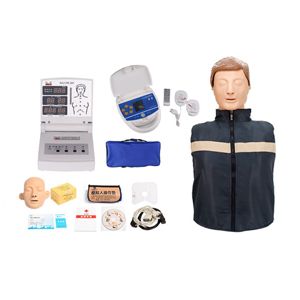
Product Description
Model | BIX/CPR230 — Computer CPR Training Manikin (Digital Feedback & Voice Prompt) |
Summary | Computer CPR manikin — digital feedback, voice prompt, and depth light indicator (green 5–6 cm zone) for CPR practice. For BLS courses and refresher training. (154 chars) |
Price | USD 382.96 |
Feedback Channels | Light indicator (green/yellow/red), voice prompt, digital scoring |
Compliance | AHA CPR & ECC guideline standards (5–6 cm depth zone) |
Applications | BLS courses, CPR certification, refresher training |
Configuration note: confirm the included accessories (practice pads, remote display) with your supplier — cpr480@adaanatomy.com.
1. Compression Quality Is the Survival Lever
Compression depth and rate are not cosmetic details — they determine perfusion. The AHA consensus statement on CPR quality identifies chest compression depth and rate as core metrics that directly influence cardiac resuscitation outcomes (Meaney et al., 2013). The 2020 AHA Guidelines for adult BLS/ALS specify:
Metric | AHA 2020 Standard |
Compression depth | 5–6 cm (2–2.4 in) |
Compression rate | 100–120 per minute |
Chest recoil | Full recoil between compressions |
Minimize interruptions | Chest compression fraction as high as possible |
The BIX/CPR230's light indicator is calibrated to this exact zone: green at 5–6 cm, yellow below 5 cm, red above 6 cm — turning the guideline's depth target into an immediate, visible signal for every single compression.
2. The Skills-Decay Problem — and Why Feedback Training Is the Answer
CPR skills do not survive certification alone. A study of 133 registered nurses found that only 63% passed BLS skills at 3 months and 58% at 12 months — and advanced skills decay even faster, with ACLS passing rates falling from 30% at 3 months to 14% at 12 months (Smith et al., 2008). Knowledge stays; psychomotor skill degrades without practice.
Feedback-equipped training is the evidence-based remedy:
● The AHA education guidelines explicitly encourage
CPR feedback devices
to help learners acquire the psychomotor skill of CPR, and recommend
more frequent training
than 2-year cycles (Bhanji et al., 2015).
● Technology-enhanced simulation produces large effects on skills and behaviors (effect sizes 1.09–1.20; Cook et al., 2011).
A manikin that tells the learner exactly when depth is too shallow (yellow), correct (green), or too deep (red) — plus a voice prompt and a numeric score — converts every practice minute into corrective feedback.
3. The Three Feedback Channels of CPR230
Channel | What It Does | Training Benefit |
Depth light indicator | Green 5–6 cm; yellow < 5 cm; red > 6 cm | Instant visual calibration per compression |
Voice prompt | Spoken guidance during practice | Hands-free correction without stopping to look |
Digital scoring | Numeric performance assessment | Objective pass/fail for testing |
Together they support the full practice loop: perform → observe feedback → correct → re-perform, which is exactly the deliberate-practice model recommended for psychomotor skill mastery (Bhanji et al., 2015).
4. Training Protocols
Station A: Compression Technique — 15 min
1. Hand position on the manikin's compression zone.
2. Compress to the green zone at 100–120/min.
3. Watch the indicator: below 5 cm → push deeper; above 6 cm → ease off.
4. Maintain full recoil between compressions.
Station B: Voice-Prompt Guided Practice — 15 min
Practice without looking at the manikin, relying on the voice prompt for correction — simulating real-world focus on the patient.
Station C: Digital Scoring Assessment — 10 min per trainee
Run a 2-minute compression test; record score, average depth, and rate. Pass standard: average depth within 5–6 cm and rate 100–120/min.
Station D: Refresher Scheduling
Given the 3-month decay curve (Smith et al., 2008), schedule skill refreshers at 3-month intervals, using the scoring function to track improvement over time (Bhanji et al., 2015).
5. Maintenance & Consumables
Item | Frequency | Notes |
Cleaning | After each class | Mild soap and damp cloth; no solvents |
Airway display | Monthly | Check the airway-opening simulation |
Battery/electronics | Per manual | Check indicator and voice functions before classes |
Consumables | On request | Ask supplier for spare list at cpr480@adaanatomy.com |
6. FAQ
Q1: What makes BIX/CPR230 different from a basic CPR manikin? A: Basic manikins give no performance feedback. CPR230 provides three channels — a depth light indicator (green 5–6 cm zone, yellow below, red above), voice prompt, and digital scoring — so learners correct every compression immediately instead of practicing errors.
Q2: Why is the 5–6 cm depth zone important? A: It is the AHA 2020 guideline standard for adult compression depth; compression quality metrics directly affect resuscitation outcomes (Meaney et al., 2013).
Q3: Does CPR230 match current AHA guidelines? A: The depth indicator is calibrated to the 5–6 cm adult standard. Note the model's stated design follows AHA CPR & ECC guideline principles — confirm the specific edition reference with your supplier if your course requires a stated guideline edition.
Q4: How does the voice prompt help training? A: It corrects technique without requiring the learner to look away from the manikin, supporting hands-on focus and faster skill acquisition.
Q5: Can the digital score be used for assessment? A: Yes — run a timed 2-minute compression test and use the score, average depth, and rate as objective pass/fail criteria.
Q6: What is the MOQ and delivery time? A: MOQ is 1 unit. Air freight: 7–10 business days; sea freight for larger orders: 30–45 days. Email cpr480@adaanatomy.com for a quote.
References
Cardiopulmonary Resuscitation Quality: Improving Cardiac Resuscitation Outcomes Both Inside and Outside the Hospital — AHA Consensus Statement — Meaney et al. (2013), Circulation 128(4):417–435
Part 3: Adult Basic and Advanced Life Support: 2020 American Heart Association Guidelines for CPR and ECC — Panchal et al. (2020), Circulation 142(16 Suppl 2):S366–S468
Evaluation of Staff's Retention of ACLS and BLS Skills — Smith et al. (2008), Resuscitation 78(1):59–65
2015 AHA Guidelines Update for CPR and Emergency Cardiovascular Care — Education — Bhanji et al. (2015), Circulation 132(18 Suppl 2):S561–S573
Technology-Enhanced Simulation for Health Professions Education: A Systematic Review and Meta-analysis — Cook et al. (2011), JAMA 306(9):978–988