
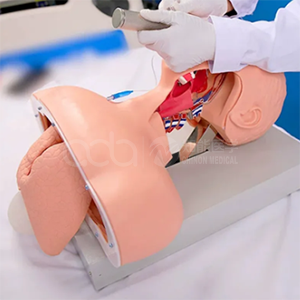
Product Description
Model | BIX-J51 — Electronic Airway Intubation Trainer |
Summary | Electronic airway intubation trainer with esophageal alarm and side-view verification — oral/nasal practice with error feedback. For medical and EMS programs. (159 chars) |
Key Feature | Esophageal intubation alarm + side-view verification |
Training Routes | Oral and nasal intubation |
Feedback | Immediate error feedback on tube misplacement |
Application | Medical education, nursing, EMS, anesthesia programs |
Price | On request |
1. Why Esophageal Intubation Is the Error to Train Against
Unrecognized esophageal intubation — a tracheal tube placed in the esophagus and not detected — is among the most dangerous complications in airway management. The UK's 4th National Audit Project (NAP4) on major airway complications identified unrecognized tube misplacement as a recurring cause of avoidable morbidity and mortality, underscoring that detection capability is as critical as insertion skill (Cook et al., 2011).
The numbers are stark: in prehospital settings without continuous tube-position verification, unrecognized misplaced intubation rates above 20% have been documented; the introduction of systematic verification (continuous capnography) drove this to near zero in the landmark EMS study (Silvestri et al., 2005).
Two training implications follow:
Trainees must learn to verify, not just insert.
1. Tube confirmation — visual (chest rise, side-view), auscultatory, and capnographic — is a taught skill that must be drilled, not assumed.
Mistakes must be visible in training.
2. A trainer that silently tolerates esophageal placement reinforces the exact error that kills patients. The J51 makes the error loud: an esophageal intubation alarm triggers the moment the tube enters the esophagus, and the side-view window allows visual confirmation of tube position — mirroring the dual-channel verification clinicians use on patients (Frerk et al., 2015; ASA, 2022).
2. Two Feedback Systems, One Clear Message
System | What It Does | Training Value |
Esophageal intubation alarm | Audible alert the moment the tube misdirects into the esophagus | Immediate, unambiguous error signal — no silent mistakes |
Side-view verification window | Visual confirmation of tube position through the model's side | Trains the "look and confirm" habit that prevents unrecognized misplacement |
Together they build the full confirmation sequence: insert → look (side-view) → listen (alarm silence = correct, alarm = error) — the same layered confirmation logic recommended by difficult airway guidelines (ASA, 2022).
3. Skill Station Protocols
Station A: Oral Intubation — 20 min
Objective: Perform direct laryngoscopy and oral intubation with correct tube placement.
Phase | Time | Trainee Action | Instructor Checkpoint |
Preparation | 3 min | Position head, select blade and tube size | Correct equipment choice |
Laryngoscopy | 7 min | Expose glottis with controlled blade force | Landmark visualization |
Intubation | 5 min | Advance tube; observe side-view window | Tube passes into trachea |
Verification | 5 min | Confirm placement (no alarm, side-view) + verbalize | Full confirmation sequence |
Station B: Esophageal Misplacement Drill — 15 min
Objective: Recognize and correct esophageal placement under pressure.
1. Intubate deliberately into the esophagus.
2. Observe the alarm trigger and side-view position.
3. Withdraw the tube immediately, ventilate, and re-attempt.
4. Repeat until the "alarm → withdraw → reattempt" reflex is automatic.
Why this drill matters: unrecognized misplacement is a failure of detection, not just technique (Cook et al., 2011). Drilling the recognition-and-correct loop builds the exact response that prevents fatal outcomes.
Station C: Nasal Intubation — 20 min
Objective: Perform nasotracheal intubation with correct passage and placement.
Step | Trainee Action | Pass Criteria |
1 | Prepare nares and tube | Correct tube sizing/lubrication |
2 | Advance tube through nasal passage | No forced resistance |
3 | Confirm placement via side-view + alarm status | Correct tracheal placement |
4 | Secure tube and verify bilaterally | Full confirmation |
Station D: Confirmation Sequence Scenario — 15 min
Objective: Apply the complete tube-confirmation algorithm in a rapid scenario.
1. Intubate under time pressure.
2. Apply the layered confirmation: side-view, alarm status, chest rise (simulated), auscultation (verbalized).
3. Decide: keep or withdraw and reattempt.
4. Debrief on decision logic with the instructor.
4. Assessment Design
Skill Checklist (Pass/Fail)
Skill | Must-Do | Common Error |
Oral intubation | Glottis visualized before tube passage | Blind passage |
Verification | Confirmation sequence completed | Skipping verification |
Esophageal drill | Immediate withdrawal on alarm | Continuing to "secure" a misplaced tube |
Nasal intubation | Correct passage + verification | Forced advancement |
Suggested Course Blocks
Course | Duration | Stations |
Basic airway skill lab (nursing/EMS) | 2 h | A + B + D |
Advanced airway program (anesthesia) | 3–4 h | A + B + C + D + assessment |
Refresher/competency check | 45 min | B + D (competency re-verification) |
5. Maintenance & Consumables
Interval | Action |
After each session | Clean airway surfaces per supplier instructions |
Monthly | Verify alarm function and side-view clarity |
Quarterly | Full inspection; replace worn airway parts |
Annually | Electronics check; order consumable sets |
For replacement parts, tubes, and consumable kits: cpr480@adaanatomy.com.
6. FAQ
Q1: What makes the J51 different from a basic intubation head? A: A basic PVC head tolerates esophageal placement silently — trainees can leave a misplaced tube in place without ever knowing. The J51 adds an esophageal intubation alarm and a side-view verification window, so misplacement is immediately visible and audible, and the "verify, don't assume" habit is drilled.
Q2: Does the trainer support both oral and nasal intubation? A: Yes — both routes are supported, with the same alarm and side-view feedback on each, enabling complete oral/nasal intubation curricula on one unit.
Q3: Why is esophageal misplacement such a focus of airway training? A: Because unrecognized esophageal intubation is a leading avoidable cause of airway-related morbidity, and detection failure — not insertion failure — is the root cause (Cook et al., 2011). Systematic verification can reduce unrecognized misplacement from >20% to near zero (Silvestri et al., 2005).
Q4: Who is the J51 suitable for? A: Medical schools, nursing programs, EMS academies, and anesthesia residency programs running basic or advanced airway skills training, including competency re-verification.
Q5: What are the main consumables? A: Tracheal tubes, airway parts, and cleaning consumables. Usage-based replacement keeps costs predictable; request the price list and recommended replacement schedule from your supplier.
Q6: What is the MOQ and delivery timeline? A: MOQ is 1 unit. Air freight: 7–10 business days. Institutional orders of 3+ units qualify for consolidated sea freight (30–45 days). Email cpr480@adaanatomy.com. for a formal quotation to your destination.
References
Major Complications of Airway Management in the UK (NAP4) — Cook et al. (2011), Br J Anaesth 106(5):617–631
Effectiveness of Continuous End-Tidal CO₂ Monitoring on Unrecognized Misplaced Intubation — Silvestri et al. (2005), Ann Emerg Med 45(5):497–503
Difficult Airway Society 2015 Guidelines for Management of Unanticipated Difficult Intubation — Frerk et al. (2015), Br J Anaesth 115(6):827–848
ASA Practice Guidelines for Management of the Difficult Airway (2022), Anesthesiology 136:e31–e81
Difficult Tracheal Intubation in Obstetrics — Cormack & Lehane (1984), Br J Anaesth 56(6):645–655