
1. The Hidden Epidemic of Pressure Injuries
Pressure injuries are among the most preventable — yet most persistent — harms in healthcare. Each year, an estimated 2.5 million patients in the United States alone develop hospital-acquired pressure injuries (HAPUs), with an associated mortality rate of approximately 60,000 deaths annually (Padula et al., 2019).
The financial burden is equally staggering. A 2019 cost analysis published in Medical Care calculated that treating a single full-thickness (Stage 4) pressure ulcer costs the healthcare system between  156,000, depending on complication severity. Multiplied across the 2.5 million annual cases, the total economic burden exceeds $26 billion per year in the US alone (Padula & Delarmente, 2019).
The first line of defense is not an expensive mattress or a high-tech monitoring system — it is a nurse who can accurately identify Stage 1 erythema before it progresses. Research by the National Pressure Injury Advisory Panel (NPIAP) has consistently shown that facilities where nursing staff receive hands-on wound staging training reduce HAPU incidence by 29–43% within the first year (Edsberg et al., 2016).
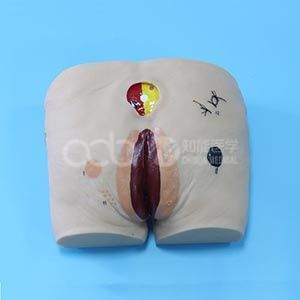
The BIX-H10 was designed to deliver precisely this hands-on competency: a single model that teaches every stage, every complication, and every dressing technique a nurse will encounter at the bedside.
2. Anatomical Realism Across Four Stages
The BIX-H10 is molded from an elderly body form — not a generic adult manikin — to replicate the tissue changes that make geriatric patients disproportionately vulnerable to pressure injuries: thinning epidermis, reduced subcutaneous fat, and decreased vascularity at bony prominences.
NPUAP Stage | Pathophysiology | BIX-H10 Representation | Clinical Training Value |
Stage 1 | Non-blanchable erythema of intact skin | Discolored, intact skin area at a bony prominence | Visual discrimination: early-stage vs. reactive hyperemia |
Stage 2 | Partial-thickness skin loss with exposed dermis | Shallow open ulcer with pink/red wound bed, no slough | Differentiation from moisture-associated skin damage (MASD) |
Stage 3 | Full-thickness skin loss; adipose tissue visible | Deep crater with undermining and tunneling | Measurement training: wound depth assessment and tunneling probe technique |
Stage 4 | Full-thickness tissue loss with exposed bone, tendon, or muscle | Exposed bone, eschar, slough, and sinus track formation | Complex wound assessment: fistula recognition and surgical referral criteria |
Additional complications displayed on the model include sutured wound edges, herpes lesions, and candidiasis — training nurses to differentiate pressure injuries from other dermatological conditions in the same anatomical field.
3. Dressing Competency: 10+ Materials on One Model
Wound dressing selection is a critical clinical decision that directly impacts healing trajectories. The International Wound Infection Institute (IWII) Consensus Document (Swanson et al., 2022) emphasizes that incorrect dressing choice — particularly occlusive dressings on infected wounds — can accelerate tissue destruction.
The BIX-H10 includes a removable dressing application surface compatible with:
● Alginate dressings (calcium/sodium alginate fiber sheets)
● Biosynthetic skin substitutes
● Collagen wound matrices
● Hydrocolloid dressings
● Hydrogel sheets and amorphous gels
● Transparent film dressings
● Wound filler/contact layer materials
● Antimicrobial silver dressings
● Foam dressings
● Gauze and non-adherent pads
The model's silicone-based wound surfaces allow repeated application and removal of dressings without material degradation — a critical feature for multi-student rotation training. Studies indicate that nursing students require an average of 12–15 supervised dressing changes to achieve competency in wound product selection (Sibbald et al., 2018).
4. The Clinical Case for Pressure Ulcer Training
The return on investment for pressure ulcer simulation training is quantifiable. A 2020 systematic review by Gaspar et al. examined 16 hospitals that implemented structured wound care simulation programs. Facilities reduced Stage 3 and 4 HAPU incidence by an average of 38% within 18 months. Extrapolating from Padula et al.'s cost data, a single prevented Stage 4 ulcer saves between 156,000 — making the BIX-H10's per-unit cost recoverable after preventing one to two serious pressure injuries across the institution's patient population.
The Joint Commission's 2023 National Patient Safety Goals list pressure injury prevention as a hospital-wide requirement (NPSG.14.01.01), including a specific mandate for ongoing nursing competency assessment in wound staging and dressing selection. The BIX-H10 provides the objective assessment platform these standards demand.
5. Wound Measurement & Documentation Training
Accurate wound documentation is a medicolegal necessity. The BIX-H10 supports training in all dimensions of wound assessment:
Length × Width × Depth
1. — using disposable measuring probes and rulers
Undermining
2. — clock-face mapping of tissue destruction beneath intact skin edges
Tunneling
3. — probing and measuring sinus tracks that extend from the wound base into deeper tissue planes
Tissue Type Classification
4. — granulation, slough, eschar, epithelialization percentage estimation
Exudate Assessment
5. — volume, color, consistency, and odor documentation
These five parameters form the minimum dataset for any wound assessment note — and the BIX-H10 provides a standardized, repeatable surface for students to practice every measurement technique before performing them on actual patients.
6. Maintenance & Care
Wound Surface Cleaning:
1. After each dressing removal, wipe silicone wound sites with mild soap and water. Avoid alcohol-based cleaners on the silicone, which may cause surface hardening over time.
Measurement Training:
2. Use only the included wound probes — metal instruments may damage the silicone wound beds.
Storage:
3. Store horizontally in a dust-free cabinet. The elderly skin molding is sensitive to prolonged UV exposure; avoid window-adjacent storage.
Expected Service Life:
4. 5–7 years under normal institutional use. The dressing application surfaces are replaceable as a consumable component.
For replacement dressing surfaces or bulk consumable orders, contact adacpr@adaanatomy.com.
7. FAQ
Q1: Does the BIX-H10 show all four NPUAP/EPUAP pressure injury stages? A: Yes. The model displays Stage 1 through Stage 4 on a single elderly body form, including the additional categories of unstageable (eschar-covered) and suspected deep tissue injury. The anatomical continuity of all stages on one model helps students understand how pressure injuries progress when left untreated.
Q2: What complications are included beyond the four stages? A: The model displays undermining, tunneling, sinus tracks, fistula formation, slough, infection, exposed bone, eschar, sutured wounds, herpes lesions, and candidiasis — training nurses in differential diagnosis of dermatological conditions that may be mistaken for or co-occur with pressure injuries.
Q3: Can real wound dressings be applied and removed repeatedly? A: Yes. The wound surfaces are silicone-based and designed for repeated application and removal of clinical wound dressings — alginates, hydrocolloids, foams, hydrogels, collagen matrices, and transparent films. This is one of the model's primary training functions.
Q4: Is this model suitable for wound care certification programs? A: Yes. The BIX-H10 is appropriate for WOCN (Wound, Ostomy, and Continence Nursing) certification preparation, CWCN/CWON examination training, and general nursing competency assessments for pressure injury staging per NPIAP guidelines.
Q5: Does the model include a dark skin tone option for Stage 1 identification training? A: Stage 1 pressure injuries present differently on dark skin tones — as persistent discoloration (purple, maroon, or blue) rather than erythema. Contact cpr480@adaanatomy.com. to inquire about skin tone variant availability for your institution.
Q6: What is the MOQ and delivery timeline? A: Standard MOQ is 1 unit. Single units ship via air freight in 7–10 business days. For nursing school deployments of 5+ units, consolidated sea freight is available at 30–45 days. Email cpr480@adaanatomy.com. for a formal quotation.
References
Economic Burden of Hospital-Acquired Pressure Injuries — Padula et al. (2019)
NPIAP Clinical Practice Guideline — Edsberg et al. (2016)
Implementation of Wound Care Simulation Programs — Gaspar et al. (2020)
Wound Dressing Product Selection and Competency — Sibbald et al. (2018)
IWII Consensus on Wound Infection — Swanson et al. (2022)
The Joint Commission 2023 National Patient Safety Goals