
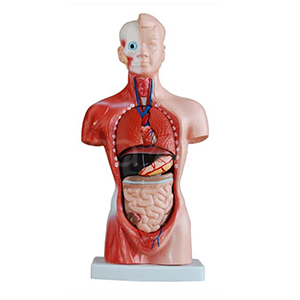
BIX-A1045 42cm Male Torso: How to Run a 13-Part Organ Identification Lab
Short answer: BIX-A1045 is a 42 cm male human anatomy torso that separates into 13 visceral pieces and sits in a base. The supplier states it is made from PVC and lists these components: the torso, a two-part head, brain, lung, heart, stomach, liver, kidney, pancreas and spleen, and intestines. It is the smallest of the male-torso class in this range, which makes it a table model for organ identification and a natural first station before students meet a larger torso.
Key takeaways
- 42 cm and PVC with a moulded base — a bench model, not a demonstration piece for a lecture hall.
- Thirteen visceral parts covering the thoracic and abdominal organs a first-year syllabus names.
- The head separates into two parts, so the brain can be removed and shown in place and out of it.
- Male-specific model, in contrast to the unisex torsos in the same range — check whether your syllabus needs both.
- Price is not published, and the published parts list does not allocate a count to every item — confirm in writing.
Published specification
| Item | Published value |
|---|---|
| Model number | BIX-A1045 |
| Description | 42cm Male Torso Anatomical Model 13 Parts — Human Anatomy Torso |
| Size | 42 cm |
| Part count | 13 |
| Material | PVC, placed in the base |
| Price | Not published — quotation on request |
Because the printed component list does not allocate a count to every item, the first step is to write to cpr480@adaanatomy.com with the model number BIX-A1045 and ask for the per-piece count list, the package dimensions and the PVC grade in writing.
The published component list, as printed
The supplier's description reads, in its own wording: "This model includes 13 pieces of visceral: torso, head (2), brain, lung, (2), (2) the heart, stomach, liver, kidney, pancreas and spleen, intestines." The list below reproduces those items; where the original does not state a count, we have not invented one.
| Component | Count as published |
|---|---|
| Torso | 1 |
| Head | 2 |
| Brain | 1 |
| Lung | 2 (count position as printed) |
| Heart | 2 (count position as printed) |
| Stomach | 1 |
| Liver | 1 |
| Kidney | 1 |
| Pancreas and spleen | Listed as one entry — count not stated |
| Intestines | 1 |
Two practical consequences follow. First, if the per-item counts must add to exactly 13 for your inventory or teaching records, ask the supplier to confirm the allocation — the page as printed commends itself to a written check. Second, the pancreas and spleen are named, which is more than many budget torsos offer, and worth verifying as a single combined piece or two separate ones.
How to run the lab: a five-step sequence
- Establish the cavities first. With the model intact, have students name the thoracic and abdominal cavities and what belongs in each. BIX-A1045 is small enough that the whole layout is visible to a table of four.
- Remove system by system, not organ by organ. Take out the lungs, then the heart, then the abdominal block. This teaches the relationships that a labelled diagram flattens, and it is the reason to use a physical torso at all [1].
- Use the two-part head as its own station. Detach the head, open it, and treat the brain as a separate short exercise — then replace it and ask what is now hidden.
- Run a rebuild test. Hand the separated parts to a student and ask them to reconstruct the torso, naming each organ as they place it. Reassembly tests relational knowledge, not recall of a list.
- Log the parts. Thirteen removable pieces in a shared teaching room live or die by the inventory sheet. Count the parts in and count them out.
Male torso against unisex torso: which to buy
| Syllabus need | Model to choose |
|---|---|
| Core organ identification, thoracic and abdominal | A male or unisex torso of any size in this class will do. |
| Reproductive anatomy of both sexes | A unisex torso with interchangeable male and female genitalia, or two separate torsos. |
| Small tutorial groups needing many units | The 42 cm class — several units per budget, one per table. |
| Lecture demonstration | The larger classes; 42 cm is not readable across a hall. |
Why organ-relationship models matter to learning
Physical models are supported for anatomy teaching by meta-analytic evidence [2], and the wider review of anatomy education technology places physical models alongside virtual and printed alternatives rather than behind them [3]. A specific and relevant example is the account of the mesenteric model of abdominal anatomy, which exists precisely because the way abdominal organs are connected is poorly conveyed by conventional diagrams. Models that let students remove and replace organs address the same problem in a smaller way, at bench scale.
The honest limit of BIX-A1045 is scale and depth. At 42 cm the fine detail of some structures is simplified, and it does not show sectional planes or pathology. Treat it as the first station in an anatomy sequence, not the only one.
FAQ
Q1. What is BIX-A1045?
A 42 cm male human anatomy torso model that separates into 13 visceral pieces, made from PVC and mounted in a base.
Q2. What does it include?
As published: torso, head (2 parts), brain, lung, heart, stomach, liver, kidney, pancreas and spleen, and intestines.
Q3. Does it include male and female reproductive organs?
The model is described as a male torso and the published list does not name genitalia. If your course needs both sexes, choose a unisex torso in the same range.
Q4. Is it suitable for a lecture hall?
No — at 42 cm it is a bench and small-group model. Use a larger class in the range for lecture demonstration.
Q5. Does the published part list specify a count for every organ?
Not fully. The printed description places counts after some items and not others; the pancreas and spleen are listed together. Ask the supplier to confirm the exact count of each piece.
Q6. How do I get the price and the material data sheet?
Price is not published. Email cpr480@adaanatomy.com with the model (BIX-A1045) and your quantity, and ask for the unit price, package dimensions, the exact part-count list and the cleaning instructions in the same message.
Request a quotation
Write to cpr480@adaanatomy.com for the BIX-A1045 specification sheet and a quotation. If you are equipping several tutorial tables, say so in the enquiry: the male, female and unisex torsos in this range are all quoted against order quantity, and ordering them together is normally the cheapest way to cover a teaching floor.
References
- The mesenteric model of abdominal anatomy. Nature Reviews Gastroenterology & Hepatology. 2026.
- The effectiveness of physical models in teaching anatomy: a meta-analysis of comparative studies. Advances in Health Sciences Education. 2016.
- Advances in anatomy education: the role of virtual anatomy tables, immersive techniques, and 3D printing. A systematic review. Folia Morphologica. 2026.