
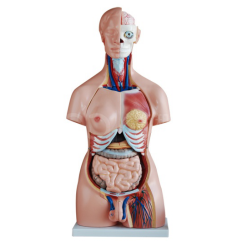
BIX-A1043: A Forty-Part Torso That Lets the Class Take Anatomy Apart
Short answer: The BIX-A1043 is an 85 cm both-sex torso model divided into 40 removable pieces and mounted on a plastic seat. The set includes the torso, a female chest cover, the head, an eyeball, an eight-piece brain, four spinal-nerve pieces, four lung pieces, a two-piece heart, trachea, oesophagus and aorta, diaphragm, liver, kidney, a two-piece stomach, four intestine pieces, four male reproductive organs and three female reproductive organs with a fetus. It is moulded in PVC, so the organs can be handled, passed around and reassembled in class.
Key takeaways
- 85 cm full-size torso model with 40 removable parts
- Eight-piece brain plus four spinal-nerve segments
- Thoracic set: lungs (4), heart (2), trachea, oesophagus, aorta, diaphragm
- Abdominal set: liver, kidney, stomach (2), intestine (4)
- Both male (4 parts) and female reproductive organs with fetus (3 parts)
- Moulded in PVC on a plastic seat; listed at US $279.94 (confirm with a written quotation)
The forty parts, grouped
| Region | Parts in the set |
|---|---|
| Head and neck | Head, eyeball, brain (8 pieces) |
| Nervous system | Spinal nerves (4 pieces) |
| Thorax | Lungs (4), heart (2), trachea, oesophagus, aorta, diaphragm |
| Abdomen | Liver, kidney, stomach (2 pieces), intestine (4 pieces) |
| Male reproductive organs | 4 pieces |
| Female reproductive organs | 3 pieces, including fetus |
| Cover / housing | Torso, female chest cover, plastic seat |
Why organ-level manipulation changes the lesson
Anatomy is a foundational course that fails students for a specific reason: complex spatial structures, dense content and high cognitive load. A 2026 randomised controlled trial published in BMC Medical Education on anatomy teaching for nursing students opens with exactly this diagnosis and notes that students struggle with the spatial complexity of the subject — which is why it tested a blended teaching model rather than more lecture time [1]. A 40-part torso answers that problem physically: every structure that is normally a label on a two-dimensional diagram becomes an object with a weight, a side and a position relative to its neighbours.
The evidence for physical models as a category is strong. Yammine and Violato's meta-analysis in Advances in Health Sciences Education (2016) pooled 8 studies — 7 randomised, 16 comparison arms, 820 learners — and found that physical anatomical models produced better factual and spatial knowledge outcomes than comparator methods [2]. Their earlier meta-analysis in Anatomical Sciences Education (2015), covering 36 studies of three-dimensional visualisation in anatomy teaching, reported the same direction of effect and flagged the prevalence of deficient anatomy knowledge among graduates as a patient-safety concern [3].
Running a practical with the BIX-A1043
- Disassemble before the class. Lay the 40 parts out and let students rebuild the torso — the assembly itself is a test of topographic knowledge.
- Work regional blocks. Take one region at a time (thorax, abdomen, pelvis) and require students to name each part and its relations before placing it.
- Use the brain set for neuroanatomy. The eight-piece brain and four spinal-nerve segments let you bridge to the nervous-system block without a second model.
- Teach sex-specific anatomy with the same unit. The male and female reproductive sets (including a fetus) mean one torso serves obstetrics and urology teaching as well.
- Close with a quiz on the model. Ask students to remove a named structure under time pressure — the same retrieval practice they will use in an OSCE.
Configuration and honest notes
The product page lists the 40 pieces above, states PVC construction and an 85 cm size, and shows US $279.94. Because these prices move with order quantity, treat the figure as indicative and ask for a written quotation and a current parts list. Spare parts availability matters on a model with 40 removable components — confirm what is replaceable before the unit goes into daily use. This is a teaching model, not a clinical device.
FAQ
Q1. How many parts does the BIX-A1043 have?
40 removable parts, including an eight-piece brain, four spinal-nerve segments, four lungs, a two-piece heart, four intestine pieces and both male and female reproductive organ sets.
Q2. Is it a male or female torso?
It is a both-sex model: it includes a female chest cover, four male reproductive organ pieces and three female reproductive organs with a fetus.
Q3. What is it made of and how large is it?
Moulded in PVC and 85 cm tall, mounted on a plastic seat.
Q4. What does it cost?
The product page lists US $279.94. Prices vary with order quantity, so email cpr480@adaanatomy.com for a firm quotation.
Q5. Can parts be replaced?
Individual components are removable; ask us for the current spare-parts list so your lab can keep the frequently handled organs in service.
Q6. Which programmes buy this model?
Medical and nursing schools, anatomy departments, physiotherapy and radiology training, and secondary-level biology departments using it for demonstration.
Request a quotation
Email cpr480@adaanatomy.com with the model (BIX-A1043), quantity and destination. Torso models are usually ordered with a skeleton model and a torso in a smaller size for bench work — we can quote the combination and the spare-part kit in one message.
References
- Effectiveness of a generative AI-powered digital tutor integrated with a knowledge graph in anatomy education for nursing students: a randomized controlled trial. BMC Medical Education. 2026
- Yammine K, Violato C. The effectiveness of physical models in teaching anatomy: a meta-analysis of comparative studies. Advances in Health Sciences Education: Theory and Practice. 2016
- Yammine K, Violato C. A meta-analysis of the educational effectiveness of three-dimensional visualization technologies in teaching anatomy. Anatomical Sciences Education. 2015