
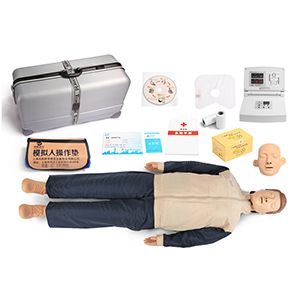
BIX/CPR480 Guide: Full-Body CPR Training with LCD Feedback and a Detachable Printer
Short answer: The BIX/CPR480 is a full-body automatic electronic CPR training manikin. It simulates a standard open airway and artificial hand-position chest compression, and it gives immediate quality feedback: a dynamic light turns green inside the correct 5–6 cm compression zone, yellow when compressions are too shallow and red when too deep; ventilation is scored against 500/600–1,000 ml; digital counters track correct and wrong attempts; and a detachable printer lets an instructor hand each candidate a printed record. It is built to the AHA 2020 CPR and ECC technique standard, priced at USD 471.32 with a 12-month warranty.
Key takeaways
- Full-body adult manikin with standard open-airway and artificial hand-position compression
- Dynamic depth light: green (5–6 cm), yellow (< 5 cm), red (> 6 cm), plus sound prompts explaining the error
- Ventilation scoring by dynamic light against 500/600–1,000 ml, with a gastric-inflation flag for excessive speed
- Digital counters for correct and wrong compressions and breaths; 30:2 ratio for one or two rescuers
- Detachable printer for printed student reports; face, neck, chest skin and hair moulded in thermoplastic elastomer for a realistic feel
- USD 471.32, 12-month warranty, ISO 13485-certified factory, global DHL / FedEx shipping
Specifications at a glance
| Item | Detail |
| Model | BIX/CPR480 |
| Type | Full-body automatic electronic CPR training manikin |
| Feedback | LCD / dynamic-light depth indicator + ventilation barcode and counters |
| Compression standard | 5–6 cm depth (AHA 2020 target range) |
| Ventilation standard | 500/600–1,000 ml |
| Ratio / cycle | 30:2 (one or two rescuers); five 30:2 blocks per cycle set |
| Documentation | Detachable printer for per-student reports |
| Materials | Face, cervical and chest skin and hair in thermoplastic elastomer, injection-moulded at high temperature |
| Price / warranty | USD 471.32 · 12-month warranty |
Why a printed score changes a CPR class
The single biggest problem in CPR teaching is that students cannot judge their own performance. In the landmark in-hospital study by Abella and colleagues, compression depth, rate and ventilation frequently fell outside guideline ranges even among trained providers who believed they were performing well [1]. Observation-based assessment inherits the same error: an instructor cannot time 110 compressions a minute and judge 5.4 cm of depth by eye across a whole class.
Real-time feedback fixes the feedback loop, and printed reports fix the record. Kramer-Johansen and colleagues showed prospectively that automated real-time feedback during resuscitation improved compression depth and rate compliance and cut pauses [2]; the AHA's CPR-quality consensus statement consequently treats feedback devices as a core teaching tool rather than an optional extra [3]. Vadeboncoeur and colleagues then linked deeper compressions inside the guideline range to better survival after out-of-hospital cardiac arrest, which is the clinical reason depth is worth measuring at all [4]. With the CPR480, that measurement is written down: the detachable printer produces a report per student, so assessment, remediation and records no longer depend on an instructor's memory of the session.
Who it suits, and a session design
- CPR / BLS certification centres issuing per-candidate competency records
- Nursing and medical schools teaching adult basic life support at scale
- EMS, fire and rescue academies running retraining cycles
- Corporate and community first-aid programmes that must document attainment
A practical session: guided practice with lights and voice prompts on; a silent run scored only by the counters so students self-correct; a two-rescuer 30:2 scenario to test coordination and handover; then a printed report per candidate for the training record.
Configuration and honest notes
The published specification lists the feedback, counter and printer functions described above. Because face/skin materials are moulded and accessories can vary by order, request the official specification sheet to confirm the delivered accessory set, spare skins and printer consumables before you plan a syllabus. This is an educational training aid, not a medical device. Assess against your current resuscitation guidelines [5].
FAQ
Q1. What is the BIX/CPR480 used for?
Full-body adult CPR and BLS training — hand-position compression, depth and rate, ventilation volume and the 30:2 sequence — with real-time feedback and printed reports.
Q2. What does the LCD feedback show?
Compression depth against the 5–6 cm zone (green correct, yellow too shallow, red too deep), ventilation volume against 500/600–1,000 ml, and correct/wrong counters for both compressions and breaths.
Q3. Is the printer included?
The model is specified with a detachable printer for operation reports. Confirm the printer and paper consumables in the delivered set with the supplier, since accessory configuration can vary by order.
Q4. How much does it cost?
The product page lists USD 471.32 with a 12-month warranty. Final price depends on quantity and destination; email us for a quotation.
Q5. How is it shipped?
Global shipping by DHL / FedEx is offered from an ISO 13485-certified factory. Lead time and freight depend on destination and quantity.
Q6. How do I get a quotation or the specification sheet?
Email cpr480@adaanatomy.com with the model (BIX/CPR480), quantity and destination; our team will send pricing, lead time and the official specification on request.
Request a quotation
Email cpr480@adaanatomy.com for the BIX/CPR480 price list and shipping details. For a mixed programme we can also quote the half-body CPR260 and the printer-equipped CPR490, so low-cost practice stations and full-featured assessment stations can coexist in one syllabus.
References
- Abella BS, Alvarado JP, Myklebust H, et al. Quality of cardiopulmonary resuscitation during in-hospital cardiac arrest. JAMA. 2005;293(3):305–310.
- Kramer-Johansen J, Myklebust H, Wik L, et al. Quality of out-of-hospital cardiopulmonary resuscitation with real time automated feedback: a prospective interventional study. Resuscitation. 2006;71(3):283–292.
- Meaney PA, Bobrow BJ, Mancini ME, et al. Cardiopulmonary resuscitation quality: improving cardiac resuscitation outcomes both inside and outside the hospital — a consensus statement from the American Heart Association. Circulation. 2013;128(4):417–435.
- Vadeboncoeur T, Stolz U, Panchal A, et al. Chest compression depth and survival in out-of-hospital cardiac arrest. Resuscitation. 2014;85(2):182–188.
- American Heart Association. CPR & ECC Guidelines. https://cpr.heart.org/en/resuscitation-science/cpr-and-ecc-guidelines