
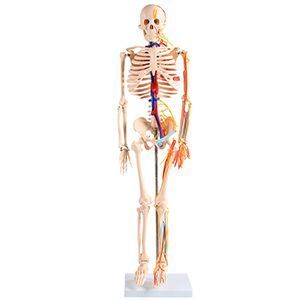
The human skeleton model with heart and blood vessels is a comprehensive teaching model that integrates the demonstration of bone structure and circulatory system. Its characteristics are mainly reflected in the following aspects:
1. High degree of structural integration
The model incorporates the heart, major blood vessels and some micro-branches into the standard skeletal structure, enabling students to observe the relative positional relationship between the bones and the circulatory system on the same model, which is conducive to deepening systematic understanding.
2. Present the course of blood vessels in three dimensions
Blood vessels are distinguished by color between arteries and veins, with clear directions. One can directly observe the large arteries and veins flowing around the bones, passing through holes and distribution areas, which is convenient for understanding the real blood circulation path of the human body.
3. The visualization of the heart structure is obvious
The heart is made to real scale, with its external structure and major vascular interfaces clearly visible, making it suitable for teaching the anatomical connections between the heart and the systemic and pulmonary circulation.
4. The learning scenarios are extensive
It can be used for anatomy teaching in medical colleges and universities, basic nursing courses, popular science training in clinical departments, etc. At the same time, it is suitable for presenting explanations related to bone and circulatory system diseases.
5. The model is durable and easy to demonstrate
Made of durable materials, with many movable joints, it is convenient for teachers to move, disassemble and assemble, and repeatedly demonstrate. It is a commonly used auxiliary tool for comprehensive theoretical and practical teaching.