
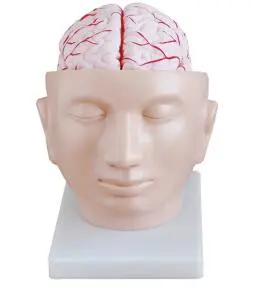
The role of the head-attached cerebral artery model is mainly reflected in three aspects: teaching demonstration, structural cognition and clinical training.
Firstly, this model combines the anatomical structure of the head with the cerebral arterial system to present, clearly showing the course and distribution of major blood vessels such as the anterior, middle and posterior arteries of the brain, as well as the basilar artery and vertebral artery, enabling learners to intuitively understand the composition and interrelationships of the cerebral blood supply network. Secondly, in classroom teaching and demonstration processes, models can assist teachers in using three-dimensional structures to explain areas that are difficult to present clearly in two-dimensional images in textbooks, such as the Willis Ring and the bifurcation of the basilar artery, which are key parts, thereby enhancing students' spatial understanding ability.
Thirdly, in clinical-related training, medical students and nursing staff can use models to learn about the occurrence areas and possible impacts of cerebrovascular diseases, such as cerebral infarction, cerebral aneurysm, and blood supply disorders, laying a foundation for imaging judgment and clinical thinking.
Overall, the head-attached cerebral artery model is an important tool for learning neuroanatomy and cerebrovascular knowledge, which can effectively improve teaching quality and learning efficiency.