
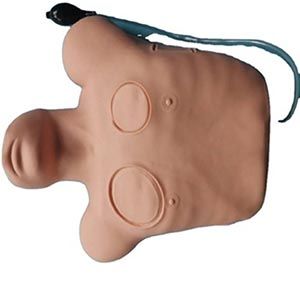
The main function of the pneumothorax treatment model is to provide an intuitive and realistic practical training platform for medical teaching and clinical training. Pneumothorax is a common and critical chest disease. If it is not identified and treated in time, it may be life-threatening. Therefore, with the help of the pneumothorax treatment model, medical students and clinical personnel can learn the pathological manifestations, clinical signs and emergency treatment steps of pneumothorax in a simulated environment. Models are usually designed with realistic thoracic structures and operable manifestations of pneumothorax, such as the simulation of tension pneumothorax, which facilitates trainees to master the key points of diagnosis through palpation, percussion and auscultation.
At the operational level, trainees can repeatedly perform key operations such as thoracentesis decompression and closed thoracic drainage on the model, familiarize themselves with the methods of needle selection, puncture site positioning and tube fixation, thereby reducing the error rate and risks in actual operations. In addition, the reusability feature of the model not only enhances teaching efficiency but also avoids the risks associated with direct practice for patients. Through this simulation training, trainees can enhance their clinical thinking and improve their emergency response and operational proficiency in the combination of theory and practice. In conclusion, the pneumothorax treatment model plays a significant role in medical education, skills training, and emergency response drills, laying a solid foundation for ensuring clinical safety.