
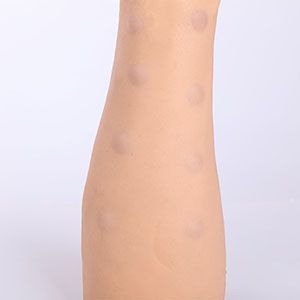
The intradermal injection jacket is a practical training tool used in clinical nursing and teaching training. It helps medical students or nurses master the basic essentials of intradermal injection by simulating the texture and elasticity of real skin. In terms of usage, first, the outer jacket needs to be properly fixed on the simulated arm or the corresponding bracket to ensure that the surface is flat and free of wrinkles, so that the needle can be inserted smoothly. Before operation, syringes, liquid medicine and disinfection supplies should be prepared, and skin disinfection should be carried out in accordance with aseptic operation norms.
In actual operation, the operator needs to gently tighten the skin on the surface of the coat with the thumb and index finger. The needle should be at an Angle of 10 to 15 degrees to the skin, with the inclined side facing upwards. Then, the needle tip should be slowly inserted into the epidermis. When the needle tip just enters the skin and forms a "cuticle", the liquid medicine can be slowly injected. Note that the injection volume should not be too large to ensure the even distribution of the liquid medicine. After completion, the needle should be removed promptly and the needle hole should be gently pressed with a dry cotton ball to prevent the liquid medicine from flowing back.
During the usage process, trainees can practice repeatedly multiple times, thereby enhancing their mastery of angles, depth and techniques. The material of the intradermal injection jacket is usually puncture-resistant and can be recycled for a certain number of times. However, it is necessary to avoid excessive force or improper angles to prevent damage to the model. After each training session, the surface of the coat should be wiped and cleaned to keep it clean and extend its service life. Through scientific use, this coat can effectively enhance the practical skills and clinical confidence of medical staff.