
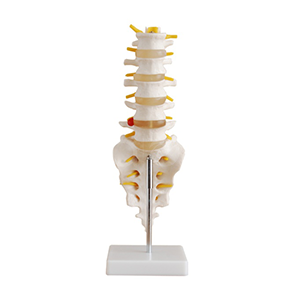
BIX-A1018 Lumbar Vertebrae Model: Why the Tail End Matters
Short answer: BIX-A1018 is a life-size model of the lumbar spine that does not stop at L5. It carries the five lumbar vertebrae with their discs, the sacrum with a flap, the coccyx, and — the part most teaching models leave out — the spinal nerves and the dura mater. That single decision, showing the neural contents inside the bony canal, is what turns a stack of bones into a model you can teach symptoms on.
Key takeaways
- Five lumbar vertebrae with discs — the segment where most mechanical low back pain is discussed.
- Sacrum with flap and coccyx included — the lumbosacral junction stays intact instead of being cut off.
- Spinal nerves and dura mater are modelled — nerve-root compression can be demonstrated, not just described.
- Life size — proportions are true, so landmark spacing is realistic.
- Price is published: USD 26.52 (subject to order quantity), with ISO and CE stated for the model.
What the model contains, and what each part teaches
| Included structure | What you can teach with it |
|---|---|
| 5 lumbar vertebrae | Vertebral body, arch and process anatomy across L1–L5, and the change in size down the column. |
| Intervertebral discs | Where load is carried, and what a disc is that the bone is not. |
| Sacrum, with flap | The lumbosacral junction — the level where the spine changes from mobile to fixed. |
| Coccyx | The terminal segment, often omitted and therefore often misidentified. |
| Spinal nerves | Where each root leaves the canal, and which level a symptom points to. |
| Dura mater | The dural sac as a physical container — the structure a lumbar puncture passes. |
| Published data | Value on the product page |
|---|---|
| Product model | BIX-A1018 |
| Scale | Life size |
| Segments | 5 lumbar vertebrae, sacrum with flap, coccyx |
| Neural contents | Spinal nerves and dura mater |
| Price | USD 26.52 (subject to order quantity) |
| Certification | ISO and CE (as published) |
| Package size / weight | Field shown but not published |
Why "with nerves and dura" is the decisive line in the specification
Lower back pain is one of the most common reasons adults consult a clinician, and the segment BIX-A1018 models is where the discussion usually starts. Degeneration is not an abstract label: the composition of the human lumbar intervertebral disc changes measurably with growth, maturation, ageing and degeneration, which is why the same level can behave completely differently at different ages [1].
Clinical decision-making in this region also turns on the relationship between bone and nerve — whether a narrowed canal or a bulging disc touches a root, and what surgery would actually change. Lumbar interbody fusion techniques are compared precisely on which approach reaches which level and how it manages that neural relationship [2]. A model that shows only vertebrae cannot teach any of that. BIX-A1018's inclusion of the spinal nerves and the dura mater is what makes the nerve-versus-bone conversation physical.
Teaching sequence
- Start with bone. Count L1 to L5 and identify the sacrum and coccyx before mentioning anything inside the canal.
- Add the discs. Ask what would change if a disc lost height, and which structures would then be at risk.
- Open the canal. Use the sacral flap to show the continuity from the lumbar canal into the sacrum.
- Trace a nerve root. Pick one level and follow the root from the canal to its exit; ask which symptoms a compression there would produce.
- Find the dura. Show the dural sac and connect it to the procedure that samples it.
- Re-assemble the story. Ask a student to explain, in order, what a patient with a problem at L4 would feel and why.
Before you order
- Confirm the neural parts are included. The nerves and dura are the differentiator — verify they are part of the standard supply, not an add-on.
- Packaging. The package size field is present but empty; request carton dimensions and gross weight.
- Quantity pricing. The published figure is stated to be subject to order quantity — state how many units you need.
- Course pairing. If you also teach trauma or pathology, ask for the pathological lumbar models in the same enquiry so both ship together.
Send these questions to cpr480@adaanatomy.com and we will answer each point and attach the current supply data.
FAQ
Q1. What is BIX-A1018?
It is a life-size model of the lumbar spine that includes the tail vertebrae, modelled from L1 down through the sacrum and coccyx.
Q2. Which structures are included?
Five lumbar vertebrae with discs, the sacrum with a flap, the coccyx, the spinal nerves and the dura mater.
Q3. Is it life size?
Yes, the model is described as life-size.
Q4. Why does it include the coccyx?
So the spine is modelled as a continuous structure down to its terminal segment, rather than stopping at the sacrum.
Q5. What is it used for?
Spine anatomy teaching, and per the published description, orthopaedics and chiropractic teaching.
Q6. What does it cost, and how do I request a quotation?
The published price is USD 26.52, subject to order quantity. Email cpr480@adaanatomy.com with the model (BIX-A1018), the quantity and your destination port.
Request a quotation
Write to cpr480@adaanatomy.com for current pricing on BIX-A1018 and for the carton dimensions and gross weight, which are not published. If your course moves from normal anatomy to pathology, ask in the same message about the pathological lumbar models in the same series.
References
- The human lumbar intervertebral disc: evidence for changes in the biosynthesis and denaturation of the extracellular matrix with growth, maturation, ageing, and degeneration. The Journal of Clinical Investigation. 1996.
- Lumbar interbody fusion: techniques, indications and comparison of interbody fusion options. Journal of Spine Surgery. 2015.