
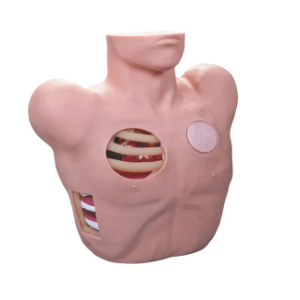
The thoracic vertebra puncture and drainage model has solved multiple problems in medical training and clinical practice, mainly including
1. Operational Skills Training : Thoracic vertebra puncture and drainage is a highly technical operation, involving precise puncture and the correct placement of the drainage tube. Through the model, medical staff can repeatedly practice, improve their operational skills, and ensure smooth completion in real scenarios.
2. Anatomical Structure Understanding : The model helps trainees gain a deeper understanding of the anatomical structure of the thoracic vertebrae region, especially the distribution of the spine, nerves and blood vessels. This helps to avoid damage to these important structures during the puncture process and reduces the occurrence of complications.
3. Enhance patient Safety : Through simulation training, medical staff can master the techniques of thoracic vertebra puncture and drainage more proficiently, reducing the risks caused by unskilled techniques in actual operations and improving patient safety.
4. Clinical Decision Support : The model helps trainees understand when to perform thoracic puncture and drainage, how to determine if it is suitable for drainage, etc., enhancing their clinical judgment ability and decision-making level.
5. Emergency Response Capability : Thoracic puncture and drainage are typically used to treat conditions such as pleural effusion and empyema. Through model training, medical staff can handle emergencies or critical conditions quickly and effectively.
Overall, the thoracic puncture and drainage model has addressed multiple challenges faced by medical staff in terms of operational accuracy, anatomical knowledge, patient safety, and clinical decision-making.