
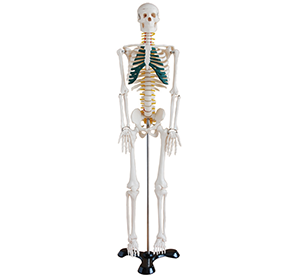
The human skeletal band neural model is mainly used in medical teaching and clinical demonstration, and it is an important tool for connecting anatomical theory with practice. This model, on the basis of a complete presentation of the human skeletal structure, simultaneously shows the main peripheral nerves and their course relationships, enabling learners to intuitively understand the spatial positions and functional connections among bones, joints and nerves. By observing the model, students can clearly grasp the distribution characteristics of nerves at different bony landmarks, which is conducive to deepening their understanding of the mechanism of nerve injury, compression syndrome and related diseases.
In teaching applications, this model is applicable to courses such as anatomy, surgery, orthopedics and rehabilitation medicine, and can assist teachers in systematic explanations, enhancing the intuitiveness of the classroom and learning efficiency. Meanwhile, in clinical training, it can be used for preoperative demonstration and operation planning, helping medical staff become familiar with the anatomical course of important nerves and reducing surgical risks. In addition, the human skeletal band neural model is also frequently used in health science popularization and patient communication, making complex medical knowledge more vivid and understandable, and has high teaching and practical value.