
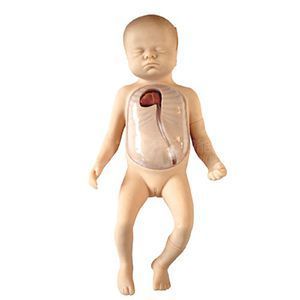
The peripheral central venous intubation model for neonates is mainly applied in clinical nursing teaching, practical training for medical students and professional skills training in neonatology. This model realistically simulates the venous structure of the upper or lower limbs of newborns, enabling trainees to practice the entire process of puncture, catheter insertion, fixation and maintenance in a simulated environment, thereby familiarizing themselves with the standard procedures and precautions of peripheral central venous catheterization (PICC) for newborns.
In the teaching of nursing colleges, this model is often used in skill courses and practical training assessments to help students master the correct methods for judging the depth of intubation and confirming the position of the catheter, thereby enhancing the accuracy and safety of the operation. In hospital training, neonatal nurses can be provided with repeated practice opportunities to reduce trauma and risks to children in clinical practice. Meanwhile, this model can also be used in scientific research and the evaluation of new technologies, such as the improvement of catheter materials and the optimization of fixation methods.
Through the systematic training of this model, trainees can effectively enhance their awareness of aseptic operation and clinical emergency handling capabilities, providing a strong guarantee for the safety and success rate of intravenous therapy for newborns.