
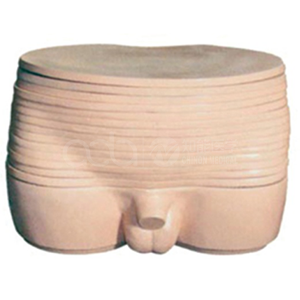
The male pelvic cross-sectional anatomical model is a highly realistic teaching tool used in medical education and clinical training, which can clearly display the cross-sectional structure of the male pelvic cavity.
Models are usually made based on real human cross-sectional images, accurately reproducing the positions and spatial relationships of important organs such as bones, muscles, blood vessels, nerves, bladder, prostate, and rectum. Through hierarchical presentation, learners can visually observe the structural changes at different anatomical levels, which helps to understand the corresponding relationship between cross-sectional anatomy and imaging.
This model is widely applied in medical anatomy teaching, imaging diagnosis training and surgical pathway research, especially of great significance for the teaching of urology, anorectal surgery and radiology. By using this model, students can better master the complex anatomical structure of the male pelvic region, improve their clinical identification ability and operational accuracy, and provide a solid theoretical foundation for clinical diagnosis and treatment.