
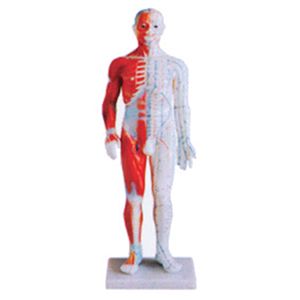
Question: What is a standard anatomical acupuncture model?
Answer: The standard anatomical acupuncture model is a teaching model made based on the real proportions of the human body and the theories of traditional Chinese acupuncture. It accurately marks the locations of the fourteen meridians, the eight extraordinary meridians, and commonly used acupoints, taking into account both the traditional Chinese meridian system and the modern human anatomical structure. It is both scientific and practical.
Question: What are the main features of this model?
Answer: The model is made of environmentally friendly materials, with a clear structure and standardized acupoint markings. Some models also have a detachable design, making it convenient to observe the corresponding relationships among muscles, bones and internal organs. It can visually display the direction of meridians and the distribution of acupoints, making the abstract theory of acupuncture more visual.
Question: How is it applied in teaching and clinical training?
Answer: Teachers can use this model to conduct acupoint location teaching, demonstrate the depth and Angle of acupuncture, help students master standard operation norms, and enhance practical skills. For clinicians, it can also be used for case explanations and patient health science popularization.
Question: What is its significance in medical education?
Answer: The standard anatomical acupuncture model effectively combines traditional Chinese medicine theory with modern anatomical knowledge, promoting the unity of theory and practice, enhancing students' sense of space and clinical application ability, and is an indispensable important teaching tool in courses such as acupuncture and massage.