
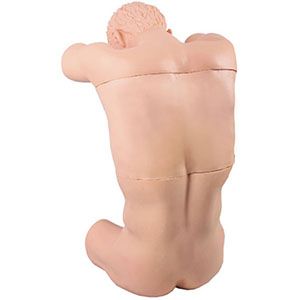
The thoracentesis training model is mainly applied in medical education and clinical skills training, and it is an important teaching tool for medical students, nurses and clinical doctors to master thoracentesis techniques.
Through this model, trainees can practice puncture operations for diseases such as pleural effusion and pneumothorax in a safe and repeatable environment, become familiar with anatomical landmarks and needle insertion sites, and master key steps such as aseptic operation, puncture Angle, needle tube connection and fluid extraction. Models usually have realistic thoracic structures and tactile sensations, which can simulate different pathological conditions and help trainees improve their practical skills under risk-free conditions.
This model is also frequently used in skills assessment and emergency drills, enabling medical staff to perform thoracic decompression and drainage operations quickly and accurately in real clinical Settings, thereby enhancing the success rate of rescue and patient safety. In the fields of teaching, assessment and scientific research, the thoracentesis training model plays an irreplaceable practical teaching value.