
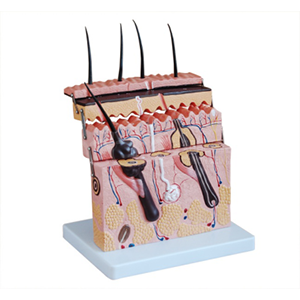
The skin section model is a teaching model used to demonstrate the structural layers and tissue composition of human skin. It is usually enlarged in a certain proportion, clearly showing the stratified structure of the epidermis, dermis and subcutaneous tissue, and marking the fine tissues such as hair follicles, sweat glands, sebaceous glands, nerve endings and blood vessels, helping learners to intuitively understand the anatomical features of the skin.
In medical teaching, skin section models are widely used in dermatology, nursing and basic anatomy courses, which helps students master the physiological functions of the skin, the perception mechanism and the occurrence sites of common skin lesions. In addition, this model can also be used for clinical skills training, such as injection site, skin test and trauma care teaching, making the learning more targeted and practical.
Overall, the skin section model is not only an important auxiliary tool for theoretical teaching, but also a bridge connecting anatomical knowledge with clinical application, helping learners deepen their systematic understanding of the structure and function of human skin.