
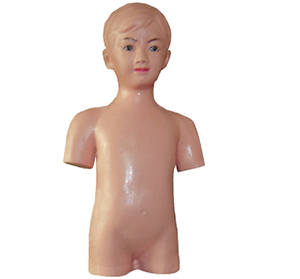
The role of the children's thoracentesis training model is mainly reflected in medical education, clinical skills training, and the improvement of emergency treatment capabilities, etc. This model is designed based on the anatomical structure of children and can realistically reproduce the anatomical features of the chest wall, intercostal Spaces and thoracic cavity, providing learners with an intuitive and realistic operating environment. During the training process, medical staff can repeatedly practice skills such as thoracentesis, fluid and gas aspiration, and drainage, thereby becoming familiar with the selection of puncture points, the control of needle insertion angles and depths, and avoiding accidental injuries caused by lack of experience in clinical operations.
Meanwhile, the materials of this model are usually flexible and realistic, capable of simulating various pathological states of the thoracic cavity, such as pleural effusion and pneumothorax, helping trainees better understand the pathophysiological changes and master the processing procedures in the simulated scenarios. Through training, not only can the operator's hand-eye coordination and operational accuracy be improved, but also their adaptability and confidence in emergency situations can be enhanced.
In addition, this model can also provide educational institutions with standardized and normalized training methods, avoiding the risks brought by operating on real children patients and ensuring the safety of the learning process. In conclusion, the children's thoracentesis training model plays a significant role in skill development, risk prevention, and the connection between clinical application.