
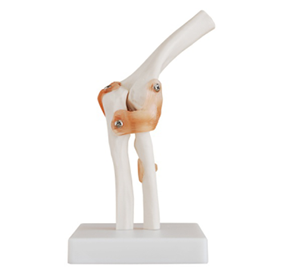
The main functions of elbow joint models lie in medical education, clinical training, and scientific research exhibitions, etc.
Firstly, it can visually reproduce the anatomical structure of the elbow joint, including the interrelationships of the humerus, ulna, radius and related ligaments and tendons, enabling learners to better understand the morphology and function of the joint. For medical students and rehabilitation professionals, the model offers a safe and intuitive teaching tool, facilitating the mastery of movement mechanisms such as flexion, extension, and rotation of the elbow joint.
Secondly, in clinical skills training, elbow joint models can be used to practice puncture, injection or fixation operations, allowing trainees to repeatedly practice in a risk-free environment to enhance their proficiency and accuracy in operations. In addition, in rehabilitation therapy and sports medicine, elbow joint models are often used as teaching equipment to help patients understand the injured area and the importance of rehabilitation training, thereby enhancing compliance.
Finally, in scientific research and academic exchanges, elbow joint models can also serve as intuitive demonstration tools to assist experts in explaining joint lesions, injury mechanisms, and surgical methods. Therefore, the elbow joint model is not only a practical tool for medical teaching but also an indispensable and important auxiliary for clinical practice and scientific research.