
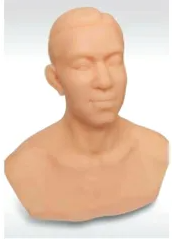
The acupuncture head training model is a simulation teaching aid specially designed for the teaching and skill training of traditional Chinese acupuncture. It is mainly used to demonstrate and practice the positioning and operation of common acupoints on the head.
This model is usually made based on the proportion of a real person's head. Its surface is marked with important acupoints such as Baihui, Yintang, Taiyang, and Fengchi, and different symbols or lines are used to distinguish the direction of meridians, helping learners to intuitively grasp the distribution pattern of acupoints on the head. When in use, trainees can touch the anatomical landmarks on the model surface, combine theoretical knowledge to find the correct acupoint positions, and then practice the operation in combination with standard acupuncture techniques. During the training process, attention should be paid to the Angle, depth and direction of needle insertion to avoid deviations, thereby cultivating the correct sense of needle insertion and operational habits.
This model is mostly made of flexible materials and can simulate the touch of skin. Some advanced versions also support repeated needle insertion, making it highly durable. After use, it should be properly cleaned and stored to ensure long-term teaching effectiveness. The acupuncture head training model is not only applicable to classroom teaching and skills assessment in traditional Chinese medicine colleges and universities, but is also frequently used in clinical training and scientific research demonstrations. It can effectively enhance students' understanding and practical application ability of meridians and acupoints on the head, laying a solid foundation for subsequent clinical acupuncture treatment.