
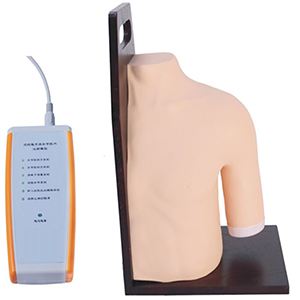
The shoulder intra-articular injection model is a medical teaching tool used for training and demonstrating shoulder intra-articular injection techniques. It is made in proportion to a real person's shoulder and precisely reproduces the bony structure of the shoulder joint, the position of the joint capsule, and the layers of the surrounding soft tissues. Most of the models are made of polymer materials and simulated skin, with a surface touch close to that of a real person. Inside, there are joint cavities for fluid injection and palpable bony landmarks such as the acromion and coracoid process, which facilitate learners to locate the needle insertion point and master the acupuncture Angle and depth. During the usage, trainees can perform needle insertion operations based on anatomical landmarks and determine whether the needle tip position is correct through liquid injection feedback or resistance sensation, which helps to build a sense of space and operational confidence. The advantages of this model lie in its retrainability , low risk , and strong intuitiveness , avoiding the discomfort and potential complication risks caused by direct practice on patients. It is widely used in orthopedics, rehabilitation, sports medicine and general practitioner training, and is suitable for teaching skills such as joint injection, fluid aspiration and drug implantation. It is an efficient training platform for improving clinical operation level.
The following operations can be performed:
1. Subacromial space closure puncture training;
2. Acromial joint closed puncture training;
3. Tendon sheath closure puncture training for the long head of the biceps brachii tendon;
4. Anterior joint socket closure puncture training;
5. Anterior joint socket closure puncture training;
6. Anterior occlusive puncture training of the suprascapular nerve;
7. After successful puncture at each puncture site, an electronic light will indicate it.